
Blog
Engineering, PPC and process: three views of this year's AI Summit
A follow-up to our AI Summit recap, from three senior colleagues in engineering, PPC and process management.
-
 Anikó Táborfi
Chief Process Officer
Anikó Táborfi
Chief Process Officer
- Published
- 1 min read
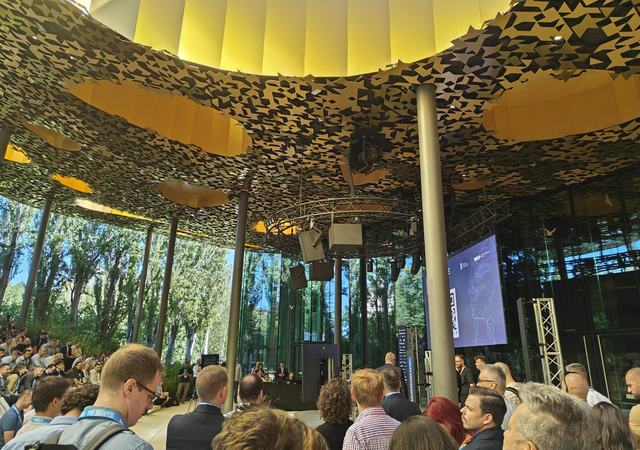
Our first recap of this year's AI Summit covered what is working, what is still hard and what comes next. Three of our senior colleagues attended the same two days, each in a different role. We asked Norbert, Edina and Anikó the same four questions: which presentation was the most interesting, what surprised them, what felt hyped, and what they want to try next.
Which was the most interesting presentation?
Norbert (Head of Application Engineering): One talk stayed with me because of a single line: "The tools are there. Without you, they are worth nothing." (Zsolt Winkler). The speaker argued that AI becomes productive through the structured thinking and domain knowledge of the people who use it. I also came away with two tools to try. Graphify AI is a shared, searchable knowledge graph that lets different AI tools reuse the same context. Graph Engineering is a workflow method that breaks a complex problem into sub-problems, each handled by a specialised sub-agent, which helps producing better quality output since the sub-agents have their own clear goal and empty context.
Edina (PPC specialist with a focus on the media industry): AWS's talk on agentic AI use cases. It described AI moving from help with individual tasks to handling part of an entire workflow. I already automate bidding, reporting and alerts, so my next question is how much of campaign management an AI agent could eventually take over. I do not think I am ready to hand over full control, but that is the direction I want to explore.
Anikó (Chief Process Officer and software testing enthusiast): The AI Society track as a whole. Our day-to-day conversations about AI tend to stay technical and close to the tools and solutions we evaluate. This track looked at how AI is changing education, mental health and other parts of society, and that wider view was eye-opening. Two talks stood out. One turned six AI-supported problem-solving methods into a practical framework for choosing the right tool for a job. The other, from Carbon.Crane, examined AI's carbon footprint and set out concrete steps to reduce it.
What surprised you the most?
Norbert: Three things. Data privacy becomes much more complicated once AI tools bring their own chains of vendors and dependencies. AI's carbon footprint is large, and tools now exist specifically to optimise prompts for lower environmental impact. And producing audience-ready video with the most advanced AI models still takes a lot of manual work, including Blender for scene consistency and detail.
Edina: How firmly the conversation has moved from generative AI to AI agents. I expected plenty of ChatGPT-style use cases such as writing, images and summaries. Some of that was there, but the more substantive discussions were about AI that carries out actions. I was also struck by how far AI-assisted media production has come, and how visibly it is starting to change the way TV content is made.
Anikó: How far legislation lags behind the spread of AI. The legal disputes now reach well beyond the familiar debates about art and copyright. Hungary's AI Guide for MarCom, presented at last year's summit, has barely been read since. I also came away with a clearer understanding of the data privacy issues involved.
What, in your opinion, was hyped?
Norbert: Some talks' point was that the newest models can do anything, easily. It skips over the domain expertise, careful prompting, context management, usage cost and legal detail that still stand between a demo and a production system.
Edina: AI agents presented as ready to run entire processes on their own. The technology is impressive, but there is still a gap between a demo and something I would trust with a live campaign and a real budget. The question I ask is whether an agent can do the work reliably enough for me to stop checking every step. I do not think it can.
Anikó: Several agentic solutions felt more complex than the problem required. My impression was that the technology was used because it was available and easy to demo, and I did not see it outperform a simpler approach.
What would you like to try next?
Norbert: Graph Engineering, and a closer look at Graphify AI as a shared knowledge space.
Edina: An agent that monitors campaign performance and flags what needs investigating, such as rising spend, a falling conversion rate or a suspicious search term. If it proves reliable, the next step would be to automate the low-risk fixes. I would rather start with one useful workflow and check whether it saves time than apply AI to everything because it is possible.
Anikó: Sustainability practices such as compressed prompts and less repeated context, along with the summit's advice on getting past the early uncertainty that slows AI adoption.
Our first recap covered what AI can already do. On the question of what AI can be trusted with, three colleagues in very different jobs reached similar answers.
If you missed it, that recap covers what is working in production, where the main challenges remain, and what leaders should ask before approving an AI project.
Where the three views meet
Each role shaped what our colleagues noticed. Norbert focused on structure and tooling, Edina on trust and who owns a workflow, and Anikó on the effects on society and on processes. Their answers also had three points in common:
- AI is moving from helping with a single task to taking on part of a workflow.
- All three were sceptical of full autonomy.
- Each of them wants to start small and show value before scaling up.
Anikó Táborfi
Chief Process Officer
With a degree in Economics and a specialisation in Total Quality Management, Anikó has spent the past 20 years building her career in software quality and testing. Over the years, she progressed through roles including Team Lead and Test Manager, gaining extensive experience in software testing methodology, test strategy, quality management, and continuous improvement.
Today, as Chief Process Officer, she applies this quality-driven mindset beyond software testing: helping improve processes across the entire organisation. Her focus is on creating efficient, sustainable ways of working that turn continuous improvement into a company-wide practice.