
Making digital campaign buying 4x faster with one planning and purchasing application connected to the ERP
How GG built the planning and buying application behind WPP Media's digital campaigns in Hungary, connected it to their ERP system and integrated GG’s SCROL and put it into production for more than 100 people.
It's extremely helpful to work with a solution-oriented team like yours, that behave like experts and put in the extra effort, instead of just blindly following instructions.
Project Summary
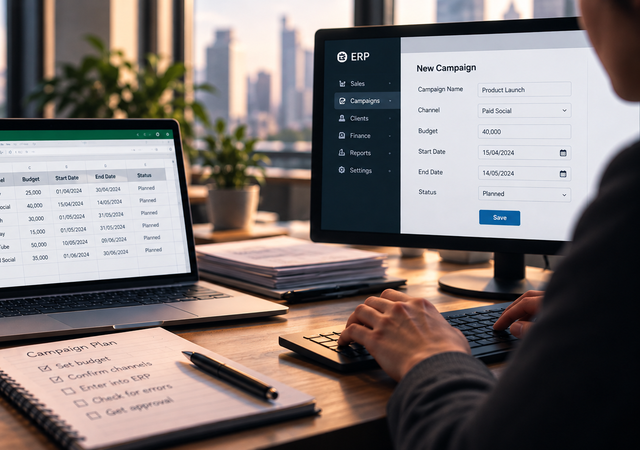
WPP Media is one of the world's largest media companies. In Hungary it is among the country's biggest media agencies, working for market-leading brands. Digital campaign planning and buying there ran on spreadsheets kept by individual planners, and the figures then had to be moved into the agency's ERP system. Finding errors in those figures depended on people double-checking them.
-
The Situation
Digital campaigns were planned in local spreadsheets, and the figures were then moved into the ERP.
-
The Risk
The agency's previous custom tool had failed after months of work, which left the agency wary of trying again.
-
The Approach
GG showed the workflow as mockups, started with the purchase process and its ERP connection, and added planning as one process for all clients when WPP Media extended the scope.
-
The result
Campaign buying 4x faster, as reported by WPP Media, with planning and buying in one application used by more than 100 people.
The Challenge
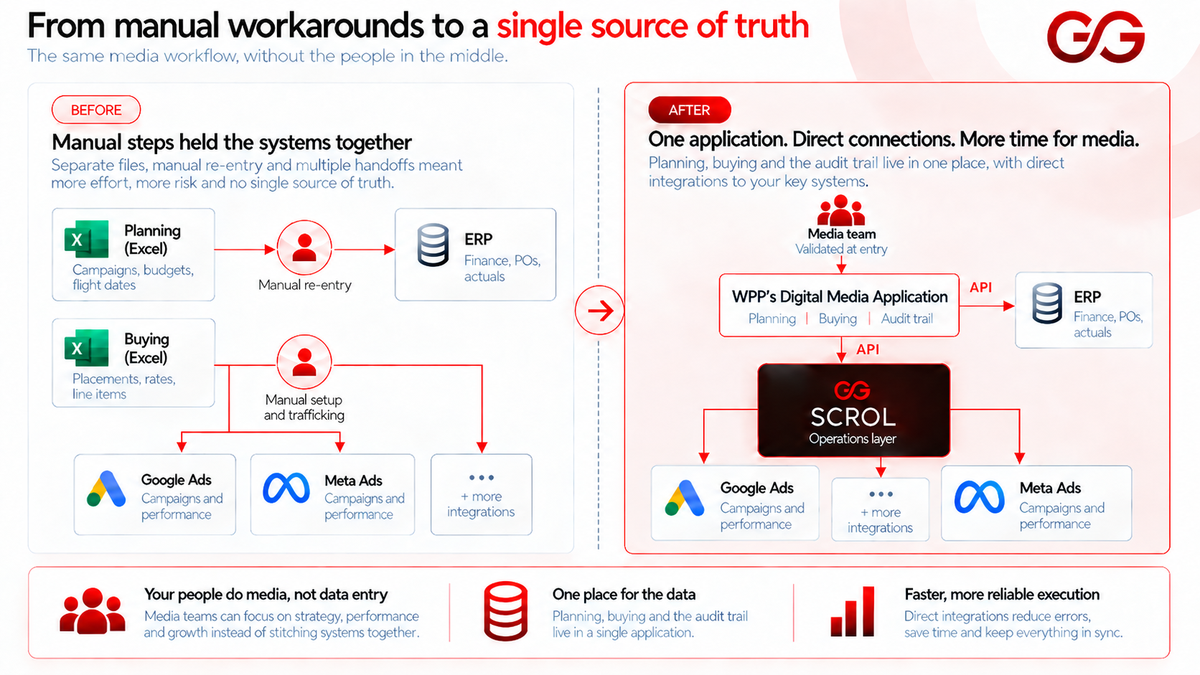
The agency's biggest pain point was the labor-intensive purchase process for digital campaigns, and the work of moving its data into the ERP, people were the integration layer. Campaign structures were built in spreadsheets where any value could go into any field, and nothing in the spreadsheet stopped a typo from being saved.
Those spreadsheets were kept locally, which made it hard for planners to move between clients. When shared market data changed, the same edit had to be made in spreadsheet after spreadsheet.
Nothing connected the spreadsheets to the ERP except the staff who moved the figures over. Delivering campaigns this way took a large amount of manual work.
The agency had already tried to solve some of this with custom software, and that attempt failed after several months of work. After that, the agency was unsure whether a custom solution would succeed.
We were a bit concerned about the development of new projects, since the previous version of the tool had failed, and several months of work went down the drain.
Risk ownership
What could not break
Two things had to remain protected:
- The figures reaching the ERP. They had to stay correct while the process that produced them was replaced.
- Planners' day-to-day work. The application had to handle every case a planner meets when creating a campaign. GG worked through those cases with WPP Media's team in many rounds of discussion.
Incremental, plan-by-plan roll-out and strict quality assurance processes supported a smooth cutover from the old, fragmented solutions to a connected one.
The Solution
The application has a planning module and a buying module, and it keeps an audit trail.
The planning module checks what planners enter and fills in values the application already knows. This cut down typos and data-entry errors, so planners spend more of their time planning and less of it checking figures.
Market data that all planners use, such as the list of sales houses, is kept in the application. When it changes, the change is made once and the users it affects are notified.
Campaign data that had been spread across separate Excel files is now in one place, including data on users, clients, campaigns and orders. The application is also integrated with Google, Meta, Google Ads, DV360, … through GG’s SCROL. We integrated WPP’s digital planning solution and use SCROL to keep track of campign delivery and capture performance data.
GG built the application so it could grow. As WPP Media's ways of working changed with the new tool, GG added features to support them.
The GG approach
GG started from the process that had already defeated one attempt, and expanded only where WPP chose to.
-
01
Understand - Workflow mapping through visual prototypes
GG mapped the campaign purchase workflow and showed it to WPP Media as screen mockups before development started. The mockups gave GG and WPP Media's team a common language for the workflow, which let the build move faster.
-
02
Connect - Purchase process and ERP integration
GG connected the purchase process to the ERP, so purchase figures no longer had to be moved over manually.
-
03
Connect - One generalized planning process
WPP Media extended the scope to planning, the first step in its workflow and one the team used every day. GG added planning to the same application as buying.
-
04
Automate - Checks and autofill in daily use
Much of the checking and updating that planners used to do themselves now happens in the application. More than 100 people use it in production.
Results
-
01
Business outcomes
- Campaign buying 4x faster, as reported by WPP Media
- Campaign figures reach the ERP directly from the application
- Planners can move between clients more easily
- Data on users, clients, campaigns and orders in one place for business decisions
-
02
Operational outcomes
- Changes to market data made once, with the affected users notified
- Locally kept Excel files replaced by one application with an audit trail
- Fewer typos and data-entry errors, since the application checks entries as they are made
-
03
Engineering outcomes
- Planning and buying modules in production, with 100+ users
- Existing ERP and over a dozen 3rd party connections in production, aligned to one operation
- Application extended as WPP Media's ways of working changed
Decisions and trade-offs
What we deliberately did not do
We did not create client-by-client versions of the planning process. Features built for a single client, agency or sales house would have meant planning worked differently from one client to the next. The process stayed the same for all of them, which makes it easier for planners to move between clients.
We did not rewrite or change systems that were good enough. Existing workflows and tool which were found to be working correctly remained, in order to minimize the needed changes to daily operations. These solutions got connected and aligned into a single operational unit for the majority of the use cases.
We did not set out to build everything from scratch. We used SCROL Enterprise to facilitate efficient cross-platform workflows while enabling strict safety and data handling requirements which adhere to global IT policy and operational criteria. This led to more efficient and faster time to market as we only needed to build the connections and customizations for the specific use cases.
Are you still using spreadsheets heavily in your day-to-day operations for planning, buying, tracking, reporting and reconciliation?
Bring us the buy-side technology problem. You do not need to arrive with a complete technical specification. Start with a bounded problem, such as a planning or buying workflow that needs better technology, or a business-critical spreadsheet that has to connect with other systems. Buy-Side AdTech Engineering covers media applications, integrations with advertising platforms and business systems, and the modernization of older media technology. We help decide what should stay, what should be connected or updated, and where custom engineering creates real operational value.
Book a 30-minute media operations call
Loading the form…
The form could not be loaded. Please email us at info@gg.dev instead.